By Talal Sohail
Frontline Engineer MAR Support
|
Ensuring efficient and high-throughput biomanufacturing puts a lot of pressure on instruments such as analyzers to perform consistently and without disruption. “Sometimes the analyzer looks perfect on the surface—but the results are atypical. That's when we dig deeper.” — Talal Sohail |
Behind the Bioreactors: How Frontline Engineers Keep Large-Scale Biomanufacturing Running
In high-throughput biologics manufacturing, a lot of strain is put on instruments such as analyzers to work consistently and without failure or disruption, despite being sensitive machines. Analyzers play a central role in bioprocess analytics, providing manufacturing-critical information (such as pH, pCO2, cell viability and density or metabolite levels) repeatedly and in a timely manner to help ensure smooth production.
In the worst-case scenario, even a single faulty analyzer can slow or stop a line, causing the teams to lose the high-frequency data that enables reliable operations — making biomanufacturing downtime prevention a critical priority in high-throughput environments.
How frontline engineering enables continuous manufacturing
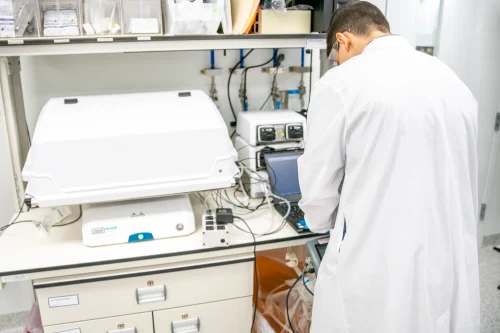
Our frontline engineering sub-team primarily supports analytical equipment used by manufacturing operators.
Almost all high-throughput facilities rely on multiple analyzers operating continuously under GMP conditions. These instruments are very precise but inherently sensitive; small issues — such as debris on a probe, a missed calibration, or a software protocol error—can ripple into unreliable data and cascading delays. This naturally can turn analyzers into production bottlenecks. That is why, in my team, we plan for redundancy, monitor performance closely and build routines that keep analyzers stable. If maintenance slips, data can drift or become unreliable—causing delays or, in the worst case, product losses.
To help navigate these risks, we deploy a two-pronged approach to ensure analyzers remain functional.
Proactive maintenance
Frontline engineering is about avoiding problems before they appear. We run disciplined, routine maintenance to keep analyzers accurate and available:
- Routine cleaning of probes, tubing and other internal components to prevent debris buildup.
- Routine calibrations and performance checks to ensure instrument accuracy.
- Weekly data backups to protect integrity in the unlikely event of power failure or data loss.
- Semi-annual part replacements to avert unexpected breakdowns.
These actions sound simple, but their impact is profound. Clean sensors read correctly. Calibrated instruments produce consistent trends. Regular data backups maintain traceability and data integrity. Planned replacements minimize surprise failures or unexpected breakdowns. As I often tell new team members: If we don’t perform routine maintenance on time, the data can start drifting or become unreliable—and that affects manufacturing production by causing delays or even product losses in the worst-case scenario.
Surveillance & rapid response
Even with strong prevention, surprises do happen once in a while at every manufacturing site. One night, a call came in at 2 AM: a cell count was needed by 5 AM, but the analyzers were locked by a protocol error. We mobilized quickly—validated the error path, performed manual checks, reset the protocol, and confirmed data integrity before releasing results. This is how we could ensure continued operations without disruption.
On another occasion, during the course of one weekend, we saw gradual performance degradation across multiple analyzers that culminated in a Monday morning analyzer shutdown. Our quick response combined diagnostics, targeted cleaning cycles, part replacements, and cross‑validation against backup instruments to swiftly restore service and avoid production disruptions.
Frontline engineering work demands technical skill and intuition. Sometimes the analyzer looks perfect on the surface—but the results are atypical. That's when we dig deeper. We use bioprocess analytics trends, system logs, and maintenance history to isolate root causes quickly. The goal isn’t just to maintain or fix an instrument—it’s to protect manufacturing continuity and confidence for operators relying on timely, trustworthy numbers.
Figure: Rapid-response workflow diagram (alert → triage & diagnose → remediate & validate → release)
Preventive rigor plus rapid response gives operations a stable platform for decision‑making. We reduce downtime, maintain reliable data streams, and help keep schedules intact. Especially when new customer projects require us to onboard new equipment.
Implementing New Analyzers Benefits From Broad Experience
When a tech transfer requires a different platform—because customers validate on different analyzers—our team also leads the end-to-end implementation so manufacturing can rely on the new system from day one. That includes:
- Platform onboarding: New system purchase and readiness, followed by Installation Qualification (IQ) and Operational Qualification (OQ) to confirm the unit is installed correctly and operating as intended.
- Lifecycle documentation: Authoring and/or assembling all required documentation—data integrity forms, design specifications, criticality assessments, risk assessments, and SOPs for both operators and system administrators.
- GMP release & handover: Coordinating release for use under GMP and ensuring the line is ready to run with appropriate procedures, training, and access controls in place.
- Post release monitoring: Tracking effectiveness checks and early performance signals so any issues are identified and resolved quickly, minimizing impact on manufacturing.
New systems are particularly demanding because failure modes are unfamiliar. That is why broad experience and problem-solving competence is important. In our team, we triage fast, leverage experience from comparable analyzers, and close gaps with targeted documentation and training, so operations stay confident in the equipment and on schedule.
Conclusion
Especially with large-scale manufacturing of new molecular formats (NMF) and complex biologics. As biomanufacturing scales, our role grows in importance. With higher throughput and diverse products, there is more potential for issues to emerge which must be resolved quickly. Frontline Engineering is built for this—combining prevention, vigilance, and fast problem‑solving to help keep critical equipment ready and production moving.
Preventive rigor combined with rapid response is central to biomanufacturing downtime prevention, helping ensure production stays on track as throughput increases and operational complexity grows. Personally, I enjoy the blend of hands‑on engineering and teamwork with colleagues in the manufacturing groups —helping operators solve problems in real time is energizing.
When customers use Lonza for their manufacturing, they might not see our work in the background, but they can trust that we are here to ensure continuous, high-quality production.
About the author:
Talal Sohail is a Frontline Engineer who primarily supports analytical equipment used by manufacturing operators at Lonza Vacaville. He leads implementation projects, troubleshoots both minor and major issues, and is on the frontline to support manufacturing production and ensure routine sampling of cell cultures.
|
|
Are you looking to bring your novel molecule to patients?Continuous manufacturing is an important aspect of operational excellence we in Lonza strive for every day. If you are looking for a CDMO partner who can simplify and strengthen your commercial biologics supply chain, don’t hesitate to reach out. |

 |